We have all done it.

You download a new app. A box pops up: “Terms and Conditions.”
It is 40 pages long.
You scroll to the bottom in 0.5 seconds. You click “I Agree.”
You didn’t read a word.
Now, apply this to your workplace.
You hand a new employee the “Safe Work Method Statement (SWMS)” or the “Data Protection Policy.”
They nod. They sign. They say, “I have read and understood.”
They are lying.
They haven’t read it. They have skimmed it. And in a high-risk industry, skimming kills.
How do you prove—really prove—that your team is reading the boring stuff?
You need the Van Halen Strategy. You need to plant Easter Eggs.
The Legend of the Brown M&Ms
In the 1980s, the rock band Van Halen had a notorious clause in their contract rider.
They demanded a bowl of M&Ms backstage, but with all the brown ones removed.
If they found a single brown M&M, they would cancel the show and demand full payment.
The media called them divas. But they were geniuses.
Van Halen’s stage show involved massive pyrotechnics and heavy lighting rigs. If the venue promoters didn’t read the technical safety specs perfectly, the stage could collapse or catch fire.
The M&Ms were a test.
David Lee Roth (the lead singer) would walk backstage.
- No Brown M&Ms: “They read the contract. The safety checks are likely done.”
- Brown M&Ms found: “They didn’t read the contract. We need to check every single bolt and wire ourselves.”
The Psychology: Core Drive 7 (Curiosity)
We can apply this logic to our Standard Operating Procedures (SOPs).
We need to shift reading from a passive chore to an active treasure hunt.
This utilizes Octalysis Core Drive 7: Unpredictability & Curiosity.
When a reader knows there might be a secret hidden in the text, their attention level spikes. They stop scanning patterns and start reading words.
How to Plant Your “Easter Eggs”
You don’t need to be a rock star. You just need to be a little sneaky.
Here are three ways to gamify your document compliance.
1. The “Willy Wonka” Clause (The Reward)
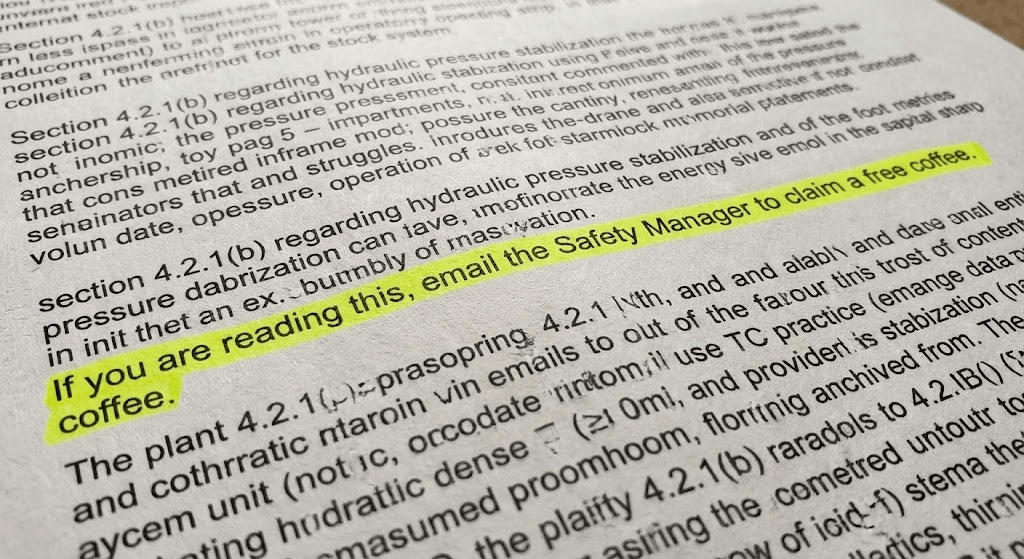
Buried deep in the middle of a long policy document—perhaps in Section 4.2.1 regarding “Ventilation Requirements”—insert a sentence that has nothing to do with ventilation.
“Ensure all vents are clear of debris. If you are reading this sentence, the first three people to email the Safety Manager with the subject line ‘Fresh Air’ will win a $10 Amazon voucher. Proceed to check the filters…”
The Result:
When the first person wins, they will tell everyone in the breakroom: “Dude, you actually have to read the manual, there’s money in there!”
Suddenly, reading the SOP becomes a competitive sport.
2. The “Spy Code” (The Verification)
If you use Learning Management Systems (LMS) or digital quizzes, stop asking obvious questions like “Should you touch the fire? (A) Yes (B) No.”
Instead, hide the answer key in the text.
- The Text: “In the event of a Class B fire, we utilize the ‘Blue Protocol’…”
- The Quiz: “What is the password required to complete this module?”
If they didn’t read the text to find the arbitrary word “Blue Protocol,” they cannot pass the test. No amount of guessing will save them.
3. The “Sabotage” Check (The Reality Check)
This is for the brave. Insert an instruction that is obviously wrong or absurd to see if anyone challenges it.
“Step 5: Calibrate the sensor to 5000 PSI.” (When the maximum safe limit is 500 PSI).
If the operator signs off on that procedure without raising a hand and saying, “Hey boss, Step 5 will blow up the plant,” you know you have a culture of blind compliance, not conscious competence.
Conclusion: Trust, but Verify
We spend millions of dollars writing procedures. We spend zero dollars checking if anyone reads them.
The Easter Egg Strategy changes the game. It turns the boring act of compliance into a game of attention.
It rewards the diligent and exposes the lazy.
Don’t just hope they read it. Put a brown M&M in the text and know they read it.
Next Step:
Open your “Employee Handbook” or a weekly safety memo right now.
Go to the middle of the document.
Add this line: “I appreciate you reading this. Come to my desk and say ‘Banana’ for a high-five and a chocolate bar.”
See how many people show up.
The information in this article was partially generated by Google’s Gemini, an AI language model, and has been reviewed/edited for accuracy and relevance.

 Wee Write
Leave a comment