
Compliance feels like running on a treadmill.
You run all year. You sweat. You work hard to stay updated on regulations, complete training, and maintain standards.
But when you step off the treadmill at the end of the year, you are in the exact same place you started.
You didn’t “win” anything. You just managed not to fall off.
This is why long-term compliance projects—like preparing for an ISO audit that is 18 months away—are so demoralizing. The goal is too far away. The daily effort feels invisible. It feels like digging a hole that immediately fills back in with dirt.
To keep people motivated on the long, boring road of compliance, we need to steal the most powerful trick in video game history: The Progress Bar.
The Psychology: The Need for “Closer”
The human brain hates open loops. It hates infinite horizons. We are wired to seek completion.
When you give an employee a goal like “Maintain 100% safety compliance for the next 365 days,” their brain cannot process that. It’s too big. It’s too abstract. There is no daily dopamine hit for doing the right thing.
Video games solved this decades ago.
In an RPG, leveling up might take 20 hours of grinding. If the game just said “Keep playing for 20 hours,” you would quit.
Instead, they give you a purple bar at the bottom of the screen. Every time you defeat a monster, that bar moves one tiny pixel to the right.
That pixel is everything.
It triggers Octalysis Core Drive 2: Development & Accomplishment. It tells your brain: “You are getting closer. Your effort matters. Do it again.”
Making the Invisible Visible
Compliance is usually an invisible state. You are compliant until you aren’t.
We need to turn compliance into a visible journey. We need to slap progress bars on everything.
Here is how to gamify the long haul.
1. The Audit Countdown Bar
Don’t just have a date on the calendar for the next external audit.
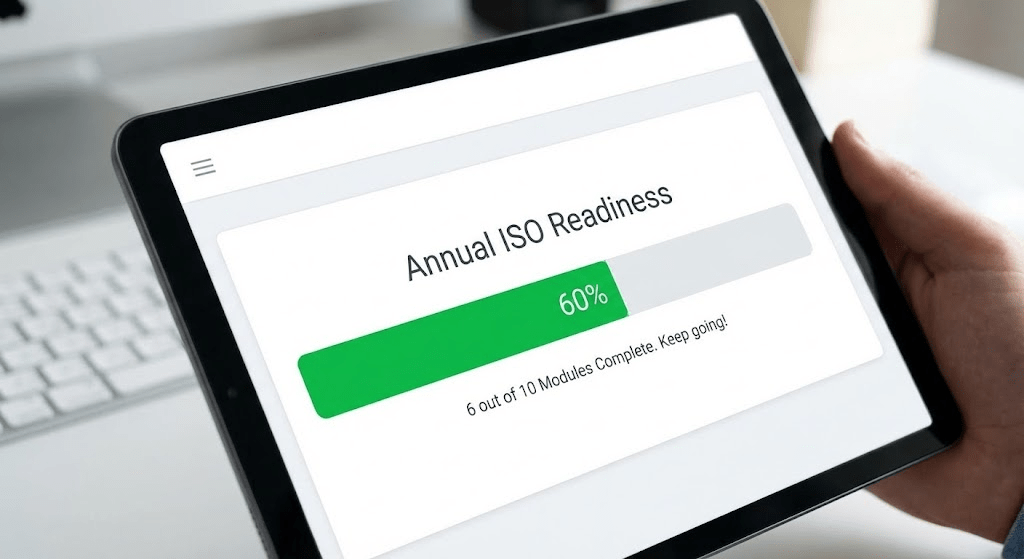
Create a “Readiness Bar” and put it on the main company dashboard.
Break the audit down into 100 discrete tasks (e.g., “Update chemical register,” “Test emergency lighting”).
- Start: [——————–] 0% Ready.
- Month 3: [|||||—————] 25% Ready.
Every time a team completes a prep task, the bar grows. Suddenly, the audit isn’t a looming threat; it’s a project being conquered one pixel at a time.
2. The Personal Training Tracker
Stop sending employees automated emails listing 20 overdue training modules. That’s just a wall of anxiety.
Give them a personal dashboard that visualizes their annual curriculum.
- “2025 Safety Curriculum: [||||||||——] 60% Complete.”
- “Just 2 more modules to reach ‘Certified’ status!”
Reframing a “To-Do List” as a “Progress Bar” shifts the mindset from “How much do I have left to do?” to “Look how much I have already done.”
3. The “Team Thermometer” (Old School Cool)
Sometimes, digital isn’t enough. For shop floor goals, go analog.
If your goal is to capture 1,000 Near-Miss reports this year, buy a giant cardboard thermometer and put it in the breakroom.
Every Friday, color it in based on the week’s submissions.
There is something viscerally satisfying about physically watching a goal get filled up. It creates a shared visual reality for the team.
Conclusion: Closing the Loop
You cannot maintain motivation on an infinite horizon. Humans need landmarks.
A progress bar turns an endless slog into a finite series of wins. It provides the critical feedback loop that boring tasks lack.
It proves to the employee that today’s effort actually moved the needle.
Stop asking your team to run on the treadmill in the dark. Turn on the lights. Show them the finish line.
Next Step:
Identify your biggest, scariest long-term compliance goal for this year.
Stop looking at it as one giant project. Break it into 10 distinct milestones.
Draw a progress bar on a whiteboard near your desk with 10 segments. Color in the first segment today. Feel that tiny hit of dopamine? That’s the point.
The information in this article was partially generated by Google’s Gemini, an AI language model, and has been reviewed/edited for accuracy and relevance.


 Wee Write
Leave a comment