
There is a distinct sound that happens when a Safety Officer walks onto a factory floor.
It is the sound of silence.
Then, the sound of safety glasses being hastily put on.
This is the failure of the “Department” model.
When Safety, Quality, or Compliance is a specific department, it creates an “Us vs. Them” dynamic.
- The Department: Enforces the rules.
- The Operations Team: Tries to get work done despite the rules.
This structure relies on Authority (Core Drive 8: Fear). It only works when the “Police” are watching.
To build a culture where compliance happens when no one is watching, we need to dismantle the silos. We need to steal a page from the software world (specifically Spotify) and replace “Departments” with “Guilds.”
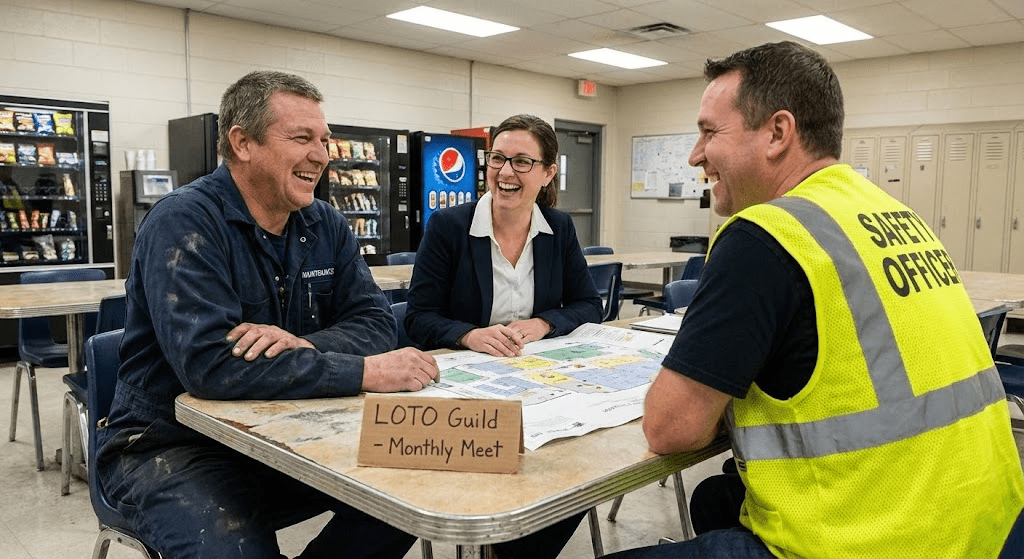
The Psychology: Social Influence (Core Drive 5)
Why do teenagers smoke? Because their friends do.
Why do teenagers stop smoking? Because their friends stop.
Human beings are driven by Octalysis Core Drive 5: Social Influence & Relatedness. We care far more about what our peers think than what our boss thinks.
- If the Safety Manager tells you to wear gloves, you do it to avoid a fine.
- If your best friend on the line tells you to wear gloves because he doesn’t want you to get hurt, you do it because you belong to the tribe.
The Spotify Model: Squads and Guilds
In the tech world, companies like Spotify realized that if you put all the Database Engineers in one room, they lose touch with the product.
So, they created a matrix.
- Squads: The teams doing the daily work (e.g., Production Line A).
- Guilds: Communities of interest that cut across the squads (e.g., The Safety Guild).
A Guild is not a department. It has no boss. It is a volunteer group of people who are passionate about a specific topic.
How to Build a “Compliance Guild”
You can apply this to your shop floor immediately. Here is the blueprint.
1. Voluntary Membership (Core Drive 3)
You cannot assign someone to a Guild. They must choose it.
Create a “Safety Guild” or a “Quality Guild.” Open it to everyone—from the receptionist to the forklift driver.
- The Pitch: “Join the Guild to design the new safety gear.”
- The Result: The people who join are your Champions. They are intrinsically motivated.
2. Cross-Pollination
A Safety Department is an echo chamber. A Safety Guild is a melting pot.
When an Accountant joins the Safety Guild, magic happens.
- The Operator explains why the new gloves are too slippery.
- The Accountant explains how much hand injuries cost the company.
- Together, they find a budget for better gloves that the Safety Manager never would have approved alone.
3. Peer-to-Peer Audits
Stop having the Safety Manager do all the audits. Let the Guild do them.
When a “Guild Member” (who is also a fellow operator) walks the floor, the dynamic changes.
It isn’t an inspection; it’s a conversation.
“Hey mate, I noticed you bypassed that sensor. We discussed in the Guild meeting how that could blow the panel. Let’s fix it.”
This is Peer Accountability. It is infinite times stronger than Management Accountability.
The Benefit: From Policing to Evangelizing
When you have Departments, you have Cops.
When you have Guilds, you have Evangelists.
A Guild member takes the message back to their daily team (their Squad) and spreads it from the inside out. They translate “Compliance Speak” into “Real Talk.”
Conclusion: Flatten the Pyramid
Hierarchy is good for command and control. It is terrible for culture.
Culture flows horizontally, friend to friend.
If you want your rules to stick, stop building taller towers (departments). Start weaving stronger nets (guilds).
Next Step:
Launch a “Pilot Guild” this week.
Topic: “The Coffee & Compliance Guild.”
Invite anyone to a 30-minute lunch to discuss one annoying rule that needs fixing.
Whoever shows up is your first Guild Member. Give them a badge.
The information in this article was partially generated by Google’s Gemini, an AI language model, and has been reviewed/edited for accuracy and relevance.

 Wee Write
Leave a comment