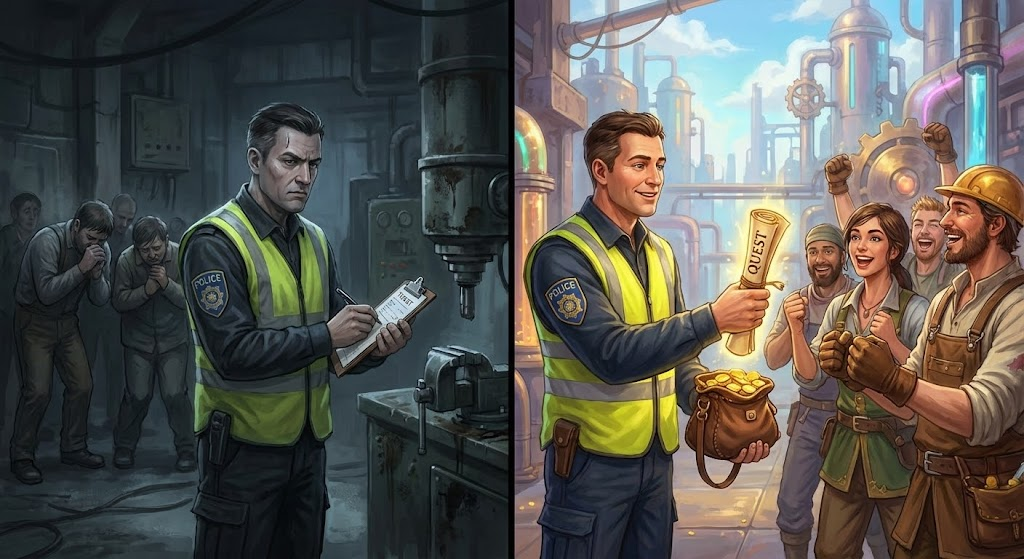
There is a specific vibe when the Safety Officer walks onto the shop floor.
The music stops. Conversations die. Tools are quickly put away. Everyone suddenly looks very busy doing exactly the right thing.
It feels like a teenager’s house party when the cops show up.
For decades, we have modeled the Internal Safety Officer after the Policeman. Their job is to patrol the beat. To catch the bad guys. To issue tickets (Non-Conformance Reports).
This model relies entirely on fear (Octalysis Core Drive 8: Loss & Avoidance).
It works… right up until the moment the Safety Officer leaves the room. Then the speeding starts again.
If you want sustainable safety culture, you need to stop being the “Fun Police.” You need to rebrand yourself.
You need to become the Quest Giver.

The NPC Analogy
In video games, there are characters known as NPCs (Non-Player Characters).
The most important NPC is the “Quest Giver.”
They don’t stop you from playing the game. They help you play it better.
- They tell you where the dragon is (Hazard Identification).
- They give you the magic sword to fight it (PPE and Training).
- They reward you with gold and XP when you return victorious (Recognition).
Players love the Quest Giver. They actively seek them out.
When was the last time a frontline employee actively sought you out just to talk about safety?
Here is how to make the shift.
1. Stop Issuing Orders, Start Issuing Challenges
A Policeman gives orders: “Wear your safety glasses.”
A Quest Giver issues a challenge (Core Drive 3: Empowerment).
- Old Way: “Ensure you follow the confined space entry procedure.”
- New Way: “This tank entry is a Level 10 difficulty mission. Your quest is to get in, do the weld, and get out with zero atmospheric alarms. Here is your gear. Good luck.”
It sounds subtle, but framing safety as a skilled challenge rather than a compliance burden changes the psychological engagement.
2. Swap Tickets for “Loot”
Policemen hand out speeding tickets. It’s negative reinforcement.
Quest Givers hand out “Loot.” It’s positive reinforcement (Core Drive 2: Accomplishment).
Stop walking around looking for things that are wrong. Walk around looking for things that are right.
When you see someone wearing their harness correctly, don’t just nod. Give them something.
- A “Safe Act” token redeemable for coffee.
- A literal gold chocolate coin (it’s silly, but it works).
- A sincere high-five.
If you want to change behavior, catch people doing it right and reward them immediately.
3. Be the Guide, Not the Guard
A guard stands in front of the hazard and says, “Stop. You can’t go in there.”
A guide stands next to you and says, “It’s dangerous in there. Here is the map to get through it safely.”
Drop the clipboard. A clipboard is a shield. It separates “Us” (management) from “Them” (workers).
Get your hands dirty. Ask the operator to teach you how the machine works. Ask them where the hidden dangers are.
When you become a student of their work, they become a student of your safety.
Conclusion: The Ultimate Unlock
Nobody likes the person who is trying to catch them out.
Everyone loves the person who is trying to help them win.
When you rebrand from enforcer to enabler, the culture shifts. People stop hiding near-misses from you. They start bringing them to you, because they know you are the one who will help them slay the dragon.
Next Step:
Tomorrow, leave your clipboard at your desk.
Go to the floor. Find one operator. Do not correct them.
Ask them this question: “What is the hardest part of your job to do safely, and what tool can I get you to make it easier?”
Listen to the answer. Then go get them that tool.
You just gave your first quest.
The information in this article was partially generated by Google’s Gemini, an AI language model, and has been reviewed/edited for accuracy and relevance.



 Wee Write
Leave a comment