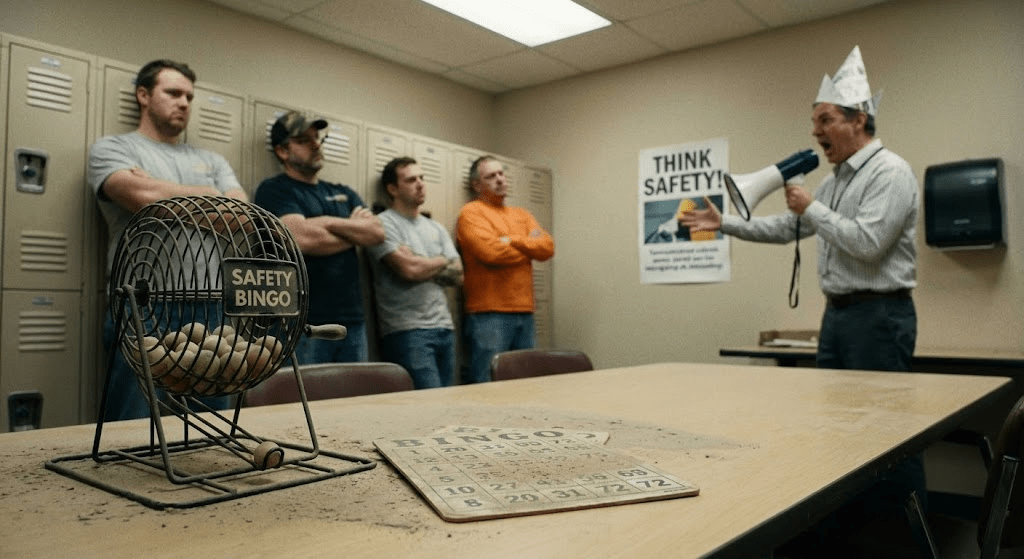
It is 8:00 AM on a Monday.
The Safety Manager walks into the toolbox talk with a megaphone and a bag of mini-chocolate bars.
“Alright team! Who is ready for lockout/tagout BINGO? Let’s make safety FUN!”
The silence is deafening. You can practically hear the eyes rolling.
This is what corporate anthropologists call “Mandatory Fun.”
It is well-intentioned. It is also a disaster for your culture.
When companies realize their safety training is boring, their first instinct is to “spice it up.” They add points, badges, and childish games to serious topics.
But when you force adults to play games they didn’t choose, you don’t get engagement. You get cynicism.
It is time to kill the mandatory fun before it kills your safety culture.

The Psychology: Why It Feels Patronizing
The problem isn’t the game. The problem is the mandate.
Gamification only works when players have Autonomy (Octalysis Core Drive 3). The definition of play is that it is voluntary.
If you have to play, it is not a game. It is just work wearing a clown nose.
When you force a highly skilled machine operator with 20 years of experience to play “Safety Word Search” for a lollipop, it feels patronizing.
It signals: “We think you are too simple-minded to care about not dying, so here is a piece of candy to make you pay attention.”
This triggers psychological reactance. They push back to regain a sense of control. The eye-roll is their way of saying, “I’m smarter than this.”
The Shift: From “Fun” to “Engaging”
We need to stop trying to make safety “fun.”
Safety is not fun. Getting your hand crushed in a press is not fun.
We need to make safety Engaging. There is a massive difference.
- “Fun” is distracting. It tries to hide the work.
- “Engaging” is focusing. It leans into the challenge of the work.
Adults do not want to be entertained at work; they want to be competent. They want to master difficult things.
How to Gamify Without the Cringe
If you want to use gamification principles without creating cynicism, you must respect your workforce.
1. Make it Voluntary (Core Drive 3)
Never force the game. Make it opt-in.
Create a “Safety Masterclass” track that involves quizzes, hazard hunts, and simulations. Let people choose to join.
The 20% who join are your champions. They are intrinsically motivated. When the others see the champions getting genuine recognition, they will join too—on their own terms.
2. Use Hard Challenges, Not Trivial Pursuits (Core Drive 2)
Stop asking trivial questions like, “What color is the fire extinguisher?”
Start offering hard challenges.
“Here is a complex confined space scenario with three conflicting variables. How would you safely plan this entry? Best plan gets presented to the Plant Manager.”
Treat them like experts solving a puzzle, not children learning the alphabet.
3. Status Over Stuff (Core Drive 5)
Forget the $5 gift cards. Adults care about reputation among their peers.
Give status.
A badge on their helmet that says “Certified Forklift Mentor” or “LOTO Tech Lead” means infinitely more than a candy bar. It signals competence to everyone on the floor.
Conclusion: Respect the Player
Cynicism is the immune system reaction to bad management.
When you see eye-rolling, it means your approach is toxic.
Stop trying to trick people into being safe with mandatory fun. Start respecting their intelligence with optional, meaningful challenges.
Next Step:
Cancel your next “Safety Bingo” session.
Instead, put a real, unsolved safety problem on a whiteboard in the breakroom.
Write: “Whoever has the best practical idea to fix this gets to lead the project to implement it.”
See what happens when you treat them like adults.
The information in this article was partially generated by Google’s Gemini, an AI language model, and has been reviewed/edited for accuracy and relevance.


 Wee Write
Leave a comment