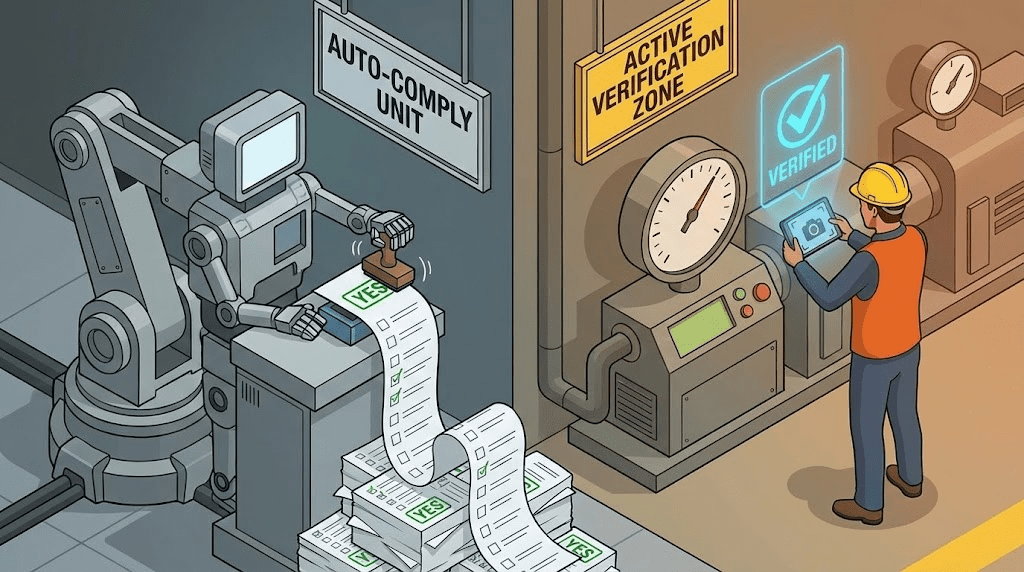
Tick. Tick. Tick. Tick. Sign.
It takes 3 seconds to complete a safety checklist that is supposed to take 10 minutes.
We call this “Pencil Whipping.”
When a manager finds a “Pencil Whipped” form—where an operator marked the fire extinguisher as “Safe” even though it was missing—the manager’s reaction is usually anger. They blame the operator. They call it laziness. They issue a warning letter.
But here is the uncomfortable truth: Pencil Whipping is not a character flaw. It is a design flaw.
If you present a human brain with a predictable, repetitive, wall-of-text list of “Yes/No” questions every single day, you are designing for non-compliance. You are fighting against millions of years of evolutionary efficiency. The brain ignores what is predictable.
If you want authentic reporting, you need to stop designing forms for auditors and start designing them for humans.
The Psychology: The “Wall of Yes”
Most safety checklists are terrible User Experience (UX).
They are long lists of 50 items. The correct answer to every single item is “Yes” (or “Safe”).
When the answer is always “Yes,” the brain disengages System 2 thinking (active, analytical) and switches to System 1 (fast, auto-pilot).
The operator isn’t looking at the machine anymore; they are looking at the pattern of the checkboxes. They are essentially playing a rhythm game: Tick, tick, tick, done.
This is driven by Octalysis Core Drive 8: Loss & Avoidance. They want to finish the task to avoid getting in trouble for not doing it. There is no incentive to actually look.
How to Fix the Design (Gamifying Authenticity)
To stop the Pencil Whip, you must break the pattern. You need to inject friction and curiosity (Core Drive 7). Here is how to redesign your inspection process.
1. The “Slot Machine” Checklist (Randomization)
A standard checklist asks the same 20 questions in the same order every day.
The Fix: Use a digital tool to randomize the questions.
- Monday: Ask about the hydraulic hoses, the guard rail, and the e-stop.
- Tuesday: Ask about the oil level, the lighting, and the waste bin.
If the operator never knows what questions will appear, they cannot “Straight Line” the form. They are forced to engage with the screen and the machine. Unpredictability (Core Drive 7) keeps the brain awake.
2. From “Tick” to “Capture” (Proof of Work)
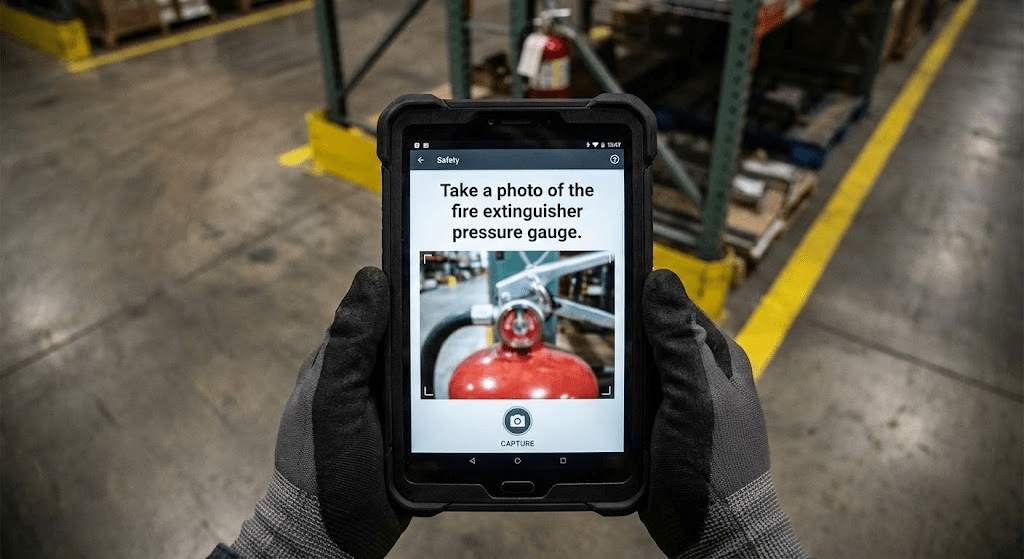
It is easy to tick a box without looking. It is impossible to take a photo without looking.
The Fix: Replace critical “Yes/No” questions with “Photo Required” prompts.
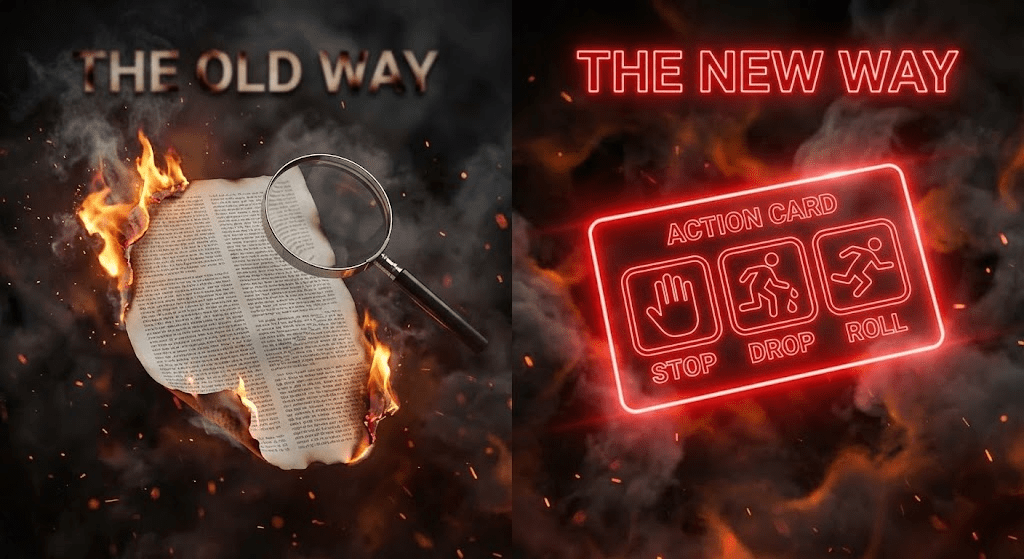
- Old Way: “Is the valve open? [ ] Yes”
- New Way: “Take a photo of the valve position.”
This shifts the psychology from Passive Compliance to Active Creation (Core Drive 3). The operator is no longer just a checker; they are a reporter. The act of framing the photo forces them to look at the asset.
3. The “Trap” Question
If you are stuck with paper forms, use a “Trap Question” to verify reading.
Insert a question where the correct answer is “No.”
- Q4: “Is the safety guard present?” (Yes)
- Q5: “Is the machine making an unusual noise?” (No)
- Q6: “Is the area clear of debris?” (Yes)
If an operator is Pencil Whipping, they will tick “Yes” for everything, effectively admitting that the machine is making a weird noise. This is a clear signal that they are on auto-pilot.
Conclusion: Respect the User
When we blame employees for Pencil Whipping, we are ignoring the fact that we gave them a boring, repetitive, unengaging tool.
We would never accept this level of bad design in a consumer app. Why do we accept it in safety critical systems?
Stop blaming the player. Fix the game.
Design a process that requires eyes, not just hands.
Next Step:
Audit your own daily checklists.
Count how many questions are on the page. If it is more than 10, cut it in half.
Then, change the order of the questions for tomorrow morning. See if anyone notices.
If they don’t, you know they aren’t reading.
The information in this article was partially generated by Google’s Gemini, an AI language model, and has been reviewed/edited for accuracy and relevance.


 Wee Write
Leave a comment