
Stop paying your workers to stay safe. You’re making them dangerous.

It sounds counterintuitive, doesn’t it? In the high-stakes world of chemical manufacturing, the “Safety Bonus” has long been the gold standard. We tell our teams: “Keep the ‘Days Since Last Accident’ clock ticking, and there’s a fat check waiting for you at the end of the quarter.”
But here’s the cold, hard truth: You aren’t buying safety. You’re buying silence.
The “Zero-Harm” Bribe and the Death of Trust
When we link cash—a powerful extrinsic motivator—to a lack of reported incidents, we trigger a dark side of human behavior. In the Octalysis Framework, this is a heavy leaning into Core Drive 8: Loss Avoidance.
Workers aren’t thinking about how to be safer; they are thinking about how not to lose their money.
This creates a massive Absence of Trust. If an operator in the process area trips over a loose grating, they have a choice:
- Report it, trigger an investigation, and potentially “kill” the bonus for the whole shift.
- Dust themselves off, stay quiet, and keep the cash.
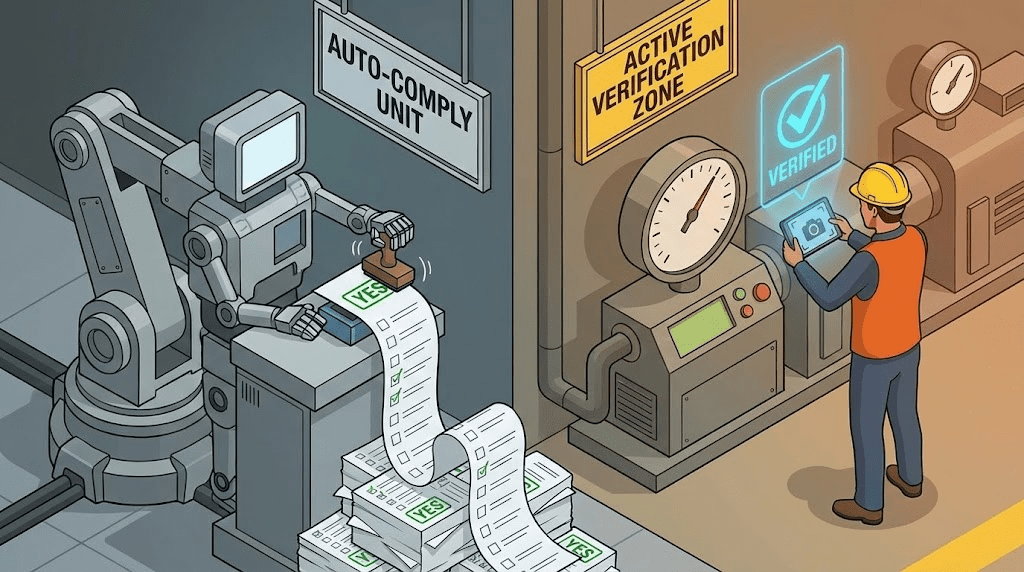
When the system rewards the outcome (zero reports) rather than the input (hazard identification), accountability vanishes. The management system becomes a weapon of surveillance rather than a tool for protection.
CD3: The Power of Empowerment and Feedback
If we want long-term compliance with ISO 45001, we have to pivot from “Bribes” to “Badges.” In Gamification, a badge isn’t just a digital icon; it’s a symbol of Core Drive 3: Empowerment of Creativity & Feedback.
Intrinsic motivation—the “Golden State”—happens when workers feel they have the agency to change their environment.
Instead of a cash bonus for “no accidents,” imagine a “Master of Hazards” badge for the worker who identifies the most creative safety solutions in a month.
- The Bribe (Cash): Ends the moment the money is spent. It leaves the worker wanting more “fuel” to keep going.
- The Badge (Recognition): Feeds the “Architecture of Ambition.” It signals to the peers that this person is a protector, a leader, and a master of their craft.
How to Gamify ISO 45001 Without Breaking the Bank
How do we move from the “Bribe” culture to a “Badge” culture? Here is your 3-step transition plan:
- Reward the “Near Miss,” Not the “Zero”: Flip your incentive. Give recognition to the teams that find the most “Pre-Accidents.” This builds “Fear of Conflict” into “Productive Conflict,” where people feel safe to challenge the status quo.
- Visual Mastery Tracking: Use a leaderboard that tracks safety contributions (audits performed, suggestions implemented) rather than just “days safe.” This taps into Core Drive 2: Development & Accomplishment.
- Human-Centric Feedback Loops: When a worker identifies a risk, don’t let it disappear into a spreadsheet. Show them the “fix” in real-time. This is the “Feedback” part of CD3. Seeing their idea turn into a physical safety guard is more addictive than a one-time bonus.
Compliance is a Shield, Not a Cage
ISO 45001 shouldn’t feel like a set of handcuffs. It should be the game engine that allows your “heroes” on the plant floor to perform at their peak without fear.
When you stop bribing people to be quiet and start empowering them to be creative, you don’t just get a safer plant. You get an organization with a soul.
The information in this article was partially generated by Google’s Gemini, an AI language model, and has been reviewed/edited for accuracy and relevance.


 Wee Write
Leave a comment