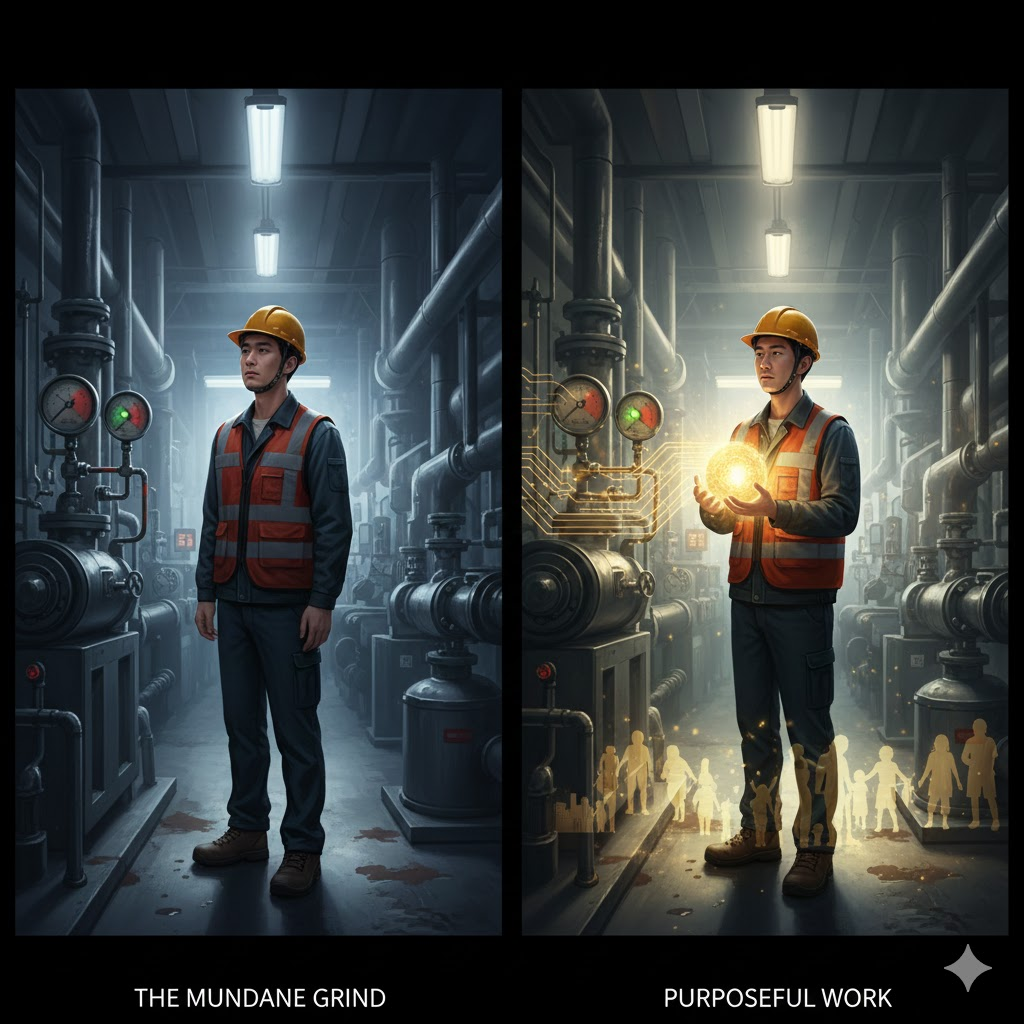
For many of us, the “battlefield” isn’t a Ming Dynasty rebellion; it’s the 9-to-5 grind. It’s the repetitive safety checks at the chemical plant, the endless spreadsheets, or the “same old” meetings in the office. It is easy to feel like a “Master of Destiny” when you are conquering mountains, but how do you maintain a “Bright Heart” when you are just staring at a pressure gauge?
This is where Viktor Frankl’s Logotherapy meets Wang Yangming’s daily practice. They both understood that if you wait for “meaning” to be handed to you by your job description, you will wait forever.
The Vacuum of the Mundane
Frankl warned of the “existential vacuum”—the feeling of emptiness that arises when life feels like a series of meaningless chores. He argued that meaning is not something a job has; it is something a person brings.
Wang Yangming taught his disciples that “polishing the heart” (磨炼) happens precisely in the middle of everyday affairs. He didn’t tell them to go to a mountain to meditate; he told them to find the “Bright Heart” while they were working, eating, and talking.
The Three Sources of Meaning
Frankl identified three ways to find meaning, even in the most mundane environments:
- Creative Value: What you give to the world. (The quality of your work at the plant ensures the safety of hundreds of people).
- Experiential Value: What you take from the world. (Finding “Flow” in the technical complexity of a system).
- Attitudinal Value: The stand you take toward a fate you cannot change.
Practical Protocol: The “Daily Grind” Transformation
To stop being a “slave to the clock” and start being a “Sage of the Mundane,” use these three shifts:
1. Look Past the Task to the Impact
A safety check is boring. Preventing an explosion that protects 500 families is a mission.
- The Practice: Connect your smallest “boring” task to the person it serves. When you clean a data set, you are clearing the path for someone else’s decision. This is Liangzhi in action.
2. The “Micro-Flow” Challenge
Csikszentmihalyi found that even assembly line workers could find Flow by turning their work into a game of speed and precision.
- The Practice: Can you do this routine task 5% better or more elegantly than yesterday? The “Master of Destiny” finds mastery in the millimeters.
3. Work as “Heart-Polishing” (磨炼)
When a colleague is difficult or a machine breaks down, don’t see it as an “interruption” to your work. See it as the actual work.
- The Lesson: That annoying situation is the “bamboo” you are observing(investigating). Your “Bright Heart” is tested not in the silence of a cave, but in the noise of the factory floor.
Your “Mundane” Exercise
Pick the most repetitive, “meaningless” task you have to do today.
- The “Why” Audit: Who is protected or helped if this task is done perfectly?
- The Flow Check: Can you do it with such total presence that you forget the time?
- The Final Smile: When it’s done, don’t just move to the next thing. Take one second to acknowledge: “此心光明” (This heart is bright). You didn’t just do a chore; you polished your soul.
我命由我不由天. Fate gives you the routine, but you give the routine its soul. When you find meaning in the mundane, the “grind” stops being a prison and starts being your training ground.
-由 Edward Wee 构思,人工智能 (Gemini) 敬撰-


Leave a Reply