
Wikipedia shouldn’t work.
In theory, an encyclopedia that anyone can edit should be a disaster of misinformation and vandalism. Yet, it is the largest, most up-to-date repository of human knowledge in history.
Why? Because of Distributed Ownership. Millions of users feel a tiny sense of responsibility for the pages they care about.
Now, look at your Business Continuity Plan (BCP).
It was likely written by a consultant or a senior manager. It is locked in a PDF. It is “perfect.” And if a pipe bursts at 3 AM on a rainy Tuesday, it is likely wrong.
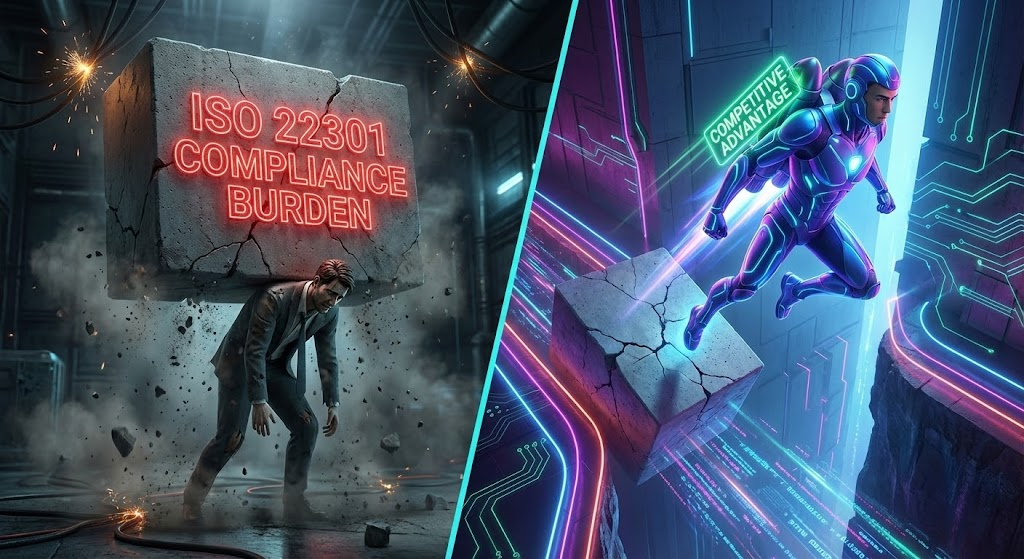
We treat resilience documents like sacred texts that can only be touched by the high priests of management. But if you want a Living BCP that actually survives reality, you need to treat it like Wikipedia. You need to let the operators edit the page.
Here is why democratizing your ISO 22301 documentation is the key to true operational resilience.

The “Ivory Tower” Gap
There is often a dangerous disconnect between “Work as Imagined” (the BCP) and “Work as Done” (Reality).
- The BCP says: “Open Valve 101 to bypass the damaged unit.”
- The Operator knows: “Valve 101 has been seized shut since 2019, so we actually have to run a hose from Point A to Point B.”
When the crisis hits, this gap causes hesitation. The team wastes the “Golden Hour” trying to follow a procedure that is physically impossible.
The Psychology: If I Wrote It, I Know It
We need to leverage The IKEA Effect (Octalysis Core Drive 4: Ownership & Possession). This cognitive bias states that we place a disproportionately high value on things we help create1.
When an operator is handed a strategy they didn’t write, they view it as a burden—a “Have To” task2. They have no emotional stake in whether it works.
However, if you invite that operator to edit the recovery procedure:
- They Own It: The strategy becomes “My Plan,” not “Management’s Plan”3.
- They Defend It: They will ensure the physical plant matches the paper plan because they wrote the paper plan.
- They Remember It: You don’t need to memorize a manual if you were the author.
How to Build the “Wiki-BCP”
You don’t need to give everyone administrative access to delete the entire server. But you do need to lower the barrier to contribution.
1. The “Living” Margin Notes
Stop discouraging people from writing on procedures. In the past, a scribbled note on a SOP was seen as “messy.” In a resilient organization, it is gold.
Encourage operators to add “Margin Notes”—digital or physical—to Process Safety Information and recovery steps4.
- Example: “Note: This pump vibrates heavily during startup; hold the reset button for 5 seconds.”
These notes capture the tribal knowledge that usually leaves the building when the operator retires.
2. The “Talk Page” Strategy
Every Wikipedia article has a “Talk Page” where editors debate the facts before publishing.
Your BCP needs this. Instead of a static “Annual Review,” create a channel (digital or physical) where shifts can debate the best recovery method.
- Shift A: “We should shut down the boiler first.”
- Shift B: “No, that trips the turbine. Isolate the steam header first.”
This debate is the resilience. By arguing about the BCP, they are mentally rehearsing the crisis5.
3. Versioning Over Approval
Traditional document control is slow. A change request takes weeks to get approved.
Adopt a “Beta Test” mindset6. Allow teams to tag a procedure as “Pending Validation” or “Version 0.9.”
Let the operators “debug” the BCP during drills. If they find a step that doesn’t work, reward them for the “bug fix” rather than punishing them for non-compliance7.
Conclusion: Trust the Tribe
The people closest to the risk are the ones best equipped to mitigate it.
Your operators know where the leaks are. They know which alarms are false. They know how to keep the plant running when the computer system crashes.
If your BCP doesn’t include their voice, it is just a theoretical novel.
Unlock the file. Hand them the keyboard. Let them build the resilience they will rely on.
Next Step:
Identify one specific “Emergency Operating Procedure” (EOP). Print it out. Put it in the breakroom with a red pen and a sign that says: “Everything wrong with this document gets you a $10 coffee card. Fix it.”
See what happens.
The information in this article was partially generated by Google’s Gemini, an AI language model, and has been reviewed/edited for accuracy and relevance.



Leave a Reply