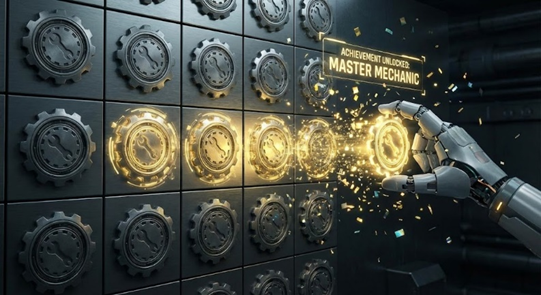
In the world of ISO 55001, the Preventive Maintenance (PM) schedule is usually a list.

It is a long, scrolling spreadsheet of tasks: “Grease Pump A,” “Inspect Valve B,” “Check Filter C.”
Psychologically, a list is exhausting. It feels infinite. As soon as you finish one task, another one appears next month. There is no sense of closure, only a sense of “maintenance” (keeping the status quo).
This is why PM compliance often lags. It relies on Core Drive 8: Loss & Avoidance (Do it so the machine doesn’t break).
But humans love to complete things. We love to fill in the last stamp on a loyalty card. We love to find the last piece of the puzzle. This is Octalysis Core Drive 4: Ownership & Possession, specifically the “Collection Set” mechanic.
Here is how to stop treating maintenance like a chore list and start treating it like a sticker album.
The Psychology: The Urge to Complete
Why do people spend hours collecting virtual trophies in video games? Because an incomplete set creates psychological tension (the Zeigarnik Effect). We remember uncompleted tasks better than completed ones, and we have a compulsion to close the loop.
In your plant, a list of 50 unconnected PMs creates no tension. But a “Set” of 5 related PMs creates a mission.
1. Break the List into “Sets”
Stop issuing individual work orders. Issue “Sets.”
- The Old Way: Operator A has 20 random tasks across the plant.
- The New Way: Operator A is assigned “The Cooling Tower Health Set.” This set includes 5 specific tasks: (1) Fan Vibration Check, (2) Basin Cleaning, (3) Chemical Dosing Check, (4) Motor Lube, (5) Structure Visual Inspection.
- The Result: The operator isn’t doing “random work.” They are completing the “Cooling Tower” chapter. When they finish 4 out of 5, the urge to finish the 5th is internal, not external.
2. Visual “Trophy Cases” for Teams
Data buried in a CMMS (Computerized Maintenance Management System) like SAP or Maximo is boring. Make it visible.
- The Strategy: Create a digital or physical dashboard that tracks “Set Completion” for each shift.
- The Visual: Use icons. When Shift A completes the “Fire Pump Set,” the Fire Pump icon turns from grey to Gold.
- The Competition: This triggers Core Drive 5 (Social Influence). If Shift B sees that Shift A has collected 5 Gold Icons this month and they only have 2, they will naturally hustle to catch up. Not because the boss yelled, but because they don’t want an empty trophy case.
3. The “Rare” Card: The Hard-to-Reach PM
Every plant has those PMs that nobody wants to do. The ones in the hot part of the plant, or the ones that require setting up scaffolding. These often get deferred (The “Backlog”).
- The Gamification: Make these the “Rare Cards” in the collection.
- The Incentive: Completing a standard PM is worth 1 point. Completing a “Rare” PM (e.g., “Chimney Top Inspection”) is worth 10 points and unlocks a special status (e.g., “High Altitude Specialist”).
- The Shift: Suddenly, the tasks people used to hide from become the tasks they fight over.
4. The “100% Run” Bonus
In gaming, a “100% Run” means you found every single item in the level.
- The Strategy: Define a “Perfect Month.” If a team completes 100% of their PM sets on time (0 deferrals), they get a tangible reward or a “Reliability Shield” (a pass to skip a non-critical meeting, or a team lunch).
- The Logic: This aligns with Asset Integrity. A machine with 90% of its PMs done is still at risk. A machine with 100% done is secure. You are rewarding the completeness of the care.

The Bottom Line
Maintenance is repetitive. You cannot change the work; the grease still needs to be pumped.
But you can change how the work is framed.
A list is a burden. A collection is a pursuit.
Stop giving your operators a bottomless pit of work orders. Give them a shelf, and tell them to fill it up.
Don’t just maintain the plant. Collect the reliability.
Credit:
The Gamification Revolution: How Gaming Mechanics Shape Our Daily Lives https://realby.info/the-gamification-revolution-how-gaming-mechanics-are-secretly-running-your-life/
The information in this article was partially generated by Google’s Gemini, an AI language model, and has been reviewed/edited for accuracy and relevance.




Leave a Reply