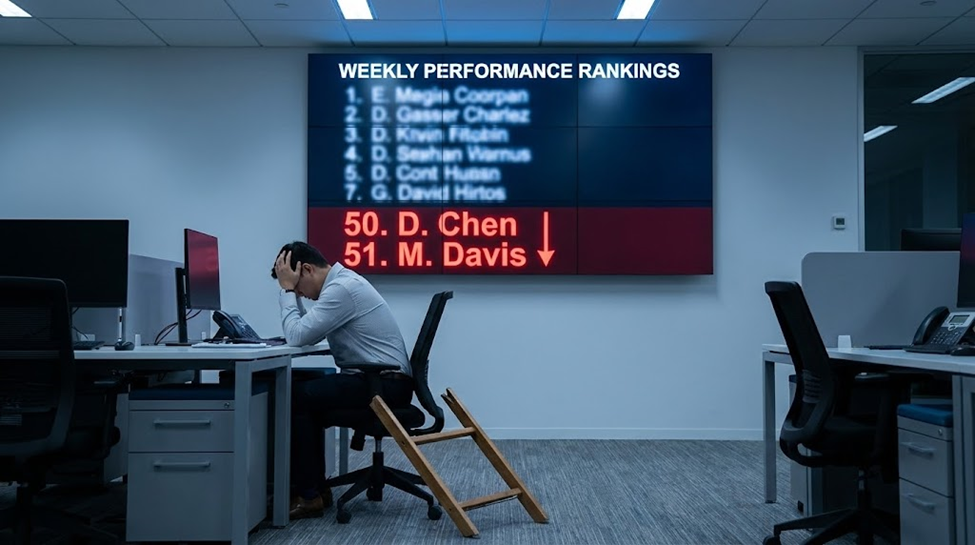
When a company decides to “gamify” its operations, the first tool they reach for is almost always the Leaderboard. It seems intuitive: display everyone’s performance publicly to spark healthy competition and drive productivity.
But we often forget the cold, hard math of rankings: for every “Top 3” winner basking in glory, there is a bottom 50% staring at their name in the “Red Zone.”
In the pursuit of engagement, many companies accidentally build a Public Humiliation Engine.
While the winners at the top enjoy a boost in Status (Core Drive 5), those on the bottom rung experience a consistent assault on their Psychological Safety. They aren’t motivated to work harder; they are motivated to hide, disengage, or sabotage the system.
Here is why the leaderboard is often the enemy of a safe, high-performing culture.
The Psychology: Status Threat and the “Freeze” Response
Psychological Safety is defined as the belief that you will not be punished or humiliated for speaking up, making mistakes, or taking risks.
A public leaderboard acts as a constant, looming threat of humiliation.
In neuroscience, a threat to our social status triggers the same pain centers in the brain as a physical blow. When an employee sees their name anchored to the bottom of a list week after week, their brain doesn’t release dopamine (motivation); it releases cortisol (stress).
This triggers the “Fight, Flight, or Freeze” mechanism. In a corporate context, “Freeze” looks like disengagement. The employee stops offering new ideas because they don’t want to risk looking even worse. They stop asking for help because it highlights their incompetence. Instead of “gamifying” improvement, the leaderboard has paralyzed the very people who need development the most.
The Culture: The “Fixed Mindset” Trap
Leaderboards often cement a culture of “Fixed Mindset.”
In a healthy culture, performance is viewed as a journey. In a leaderboard culture, performance is viewed as an identity. You are either a “Winner” or a “Loser.”
Over time, the employees stuck on the bottom rung internalize this identity. They think, “I’m just not a ‘Gold Tier’ employee, so why bother trying?” The culture bifurcates into a small elite of “Stars” who get all the resources and praise, and a silent majority of “Drifters” who feel invisible and undervalued.
This is disastrous for Operations and Audit teams. You need the entire team to be vigilant and engaged, not just the top 10%. By alienating the bottom half, you create a massive blind spot in your organization where the “losers” simply stop caring about quality or safety because they feel the game is already rigged against them.
The Cheating: Metric Fixation and Sabotage
If you back a human into a corner with a “Loss & Avoidance” (Core Drive 8) motivator, they will do whatever it takes to survive.
How do employees on the bottom rung cheat?
- Metric Hacking: They stop doing their actual job and start doing only the specific tasks that move the needle. If the leaderboard ranks “Calls Answered,” they will answer calls and hang up immediately to boost their count. They trade effectiveness for efficiency to escape the bottom.
- Sandbagging: They artificially lower expectations or hoard work to release it all at once for a temporary spike, disrupting the smooth flow of operations.
- Crabs in a Bucket: If they can’t climb up, they pull others down. We see “bottom rung” employees withholding information from “top rung” colleagues to sabotage their scores, hoping to close the gap not by rising, but by making everyone else fall.
Conclusion: Race Against Yourself, Not Others
The fix isn’t to ban data, but to change the frame.
Replace “Player vs. Player” leaderboards with “Player vs. Self” metrics. Show employees their progress compared to their own past performance (Core Drive 2: Development & Accomplishment).
If you must use leaderboards, rank Teams against Goals, not individuals against individuals. This uses Core Drive 5 to bond the group (“We need to hit the target together”) rather than tear it apart (“I need to beat you to survive”).
Psychological safety is the soil in which high performance grows. Don’t salt the earth with a leaderboard just to get a short-term productivity spike.
Credit:
Thyness, C., Grimstad, H., & Steinsbekk, A. (2023). Psychological safety in European medical students’ last supervised patient encounter: A cross-sectional survey. PLoS One, 18(4), e0285014.
The Park – Movie Sommelier https://www.moviesom.com/moviesom.php?tmdbMovieId=1084225




Leave a Reply