
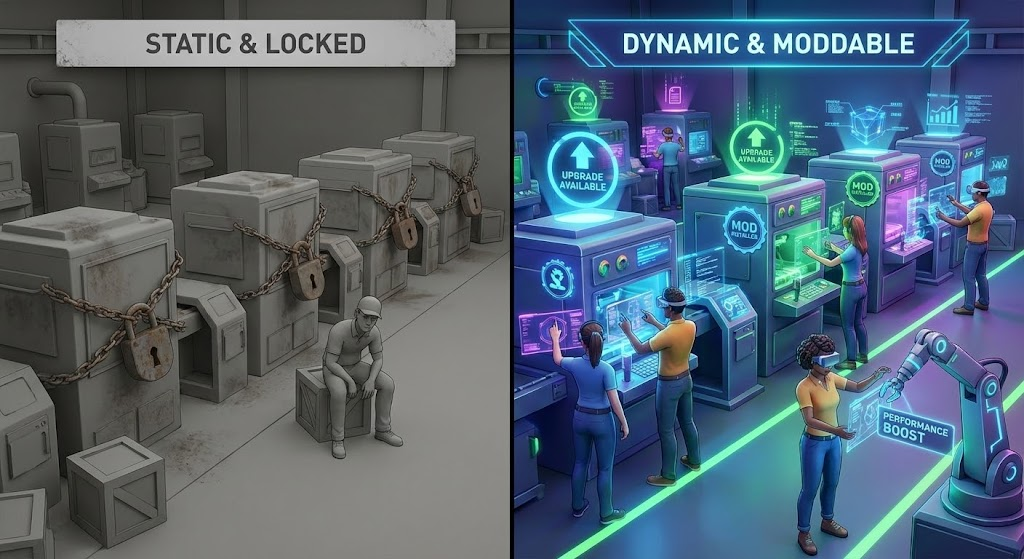
If you look at the most popular video games in history—Skyrim, Minecraft, Fallout—you find a common trend. The developers released the game, but the community kept it alive.
Players didn’t just play the game; they “Modded” it. They wrote new code, fixed bugs, and improved the graphics. They took ownership of the product and made it better than the original creators ever could.
Now, look at your chemical plant or manufacturing facility.
Your Standard Operating Procedures (SOPs) and Business Continuity Plans (BCP) are the “Game Code.” But unlike Skyrim, you have locked the code. You treat your operators like passive “Users” who must strictly follow the script.
This kills engagement. It creates a “Renter” mentality where operators ignore small problems because “it’s not my job to fix the manual”1111.
If you want true Operational Discipline and a living BCP, you need to unlock the code. You need to let your operators “Mod” the plant.

The Psychology: Why Modders Work for Free
Why do gamers spend hundreds of hours fixing a game for free?
It is Octalysis Core Drive 4: Ownership & Possession.
When you invest time and creativity into something, you value it more. This is known as the IKEA Effect2. We love the wobbly bookshelf we built more than the perfect one we bought.
When an operator is allowed to “Mod” a procedure—to rewrite a confusing step, add a photo, or clarify a warning—they stop being a compliant robot and become a Co-Creator. They defend the procedure because it contains their DNA.
How to Gamify “Modding” in Operations
You might be thinking: “We can’t just let everyone rewrite safety procedures! That’s anarchy!”
Agreed. Modding isn’t anarchy; it is peer-reviewed improvement. Here is how to apply the mechanics of the gaming community to your ISO 22301 documentation.
1. The “Patch Note” Culture
In software, when a bug is fixed, the developers release “Patch Notes.”
- The Old Way: Procedures are updated every 3 years by an engineer in an office. No one notices.
- The Mod Way: Encourage operators to submit “Patches” for the BCP.
- “I found a faster way to route the backup power cables.”
- “Step 4 is outdated; that valve was removed last year.”
- The Gamification: When a Patch is approved by the safety committee, publish a “Patch Note” to the whole plant: “Recovery Procedure v2.1 released. Optimization credits to Operator Steve.”
2. Unlock “Safe Customization”
You cannot allow operators to mod the physics (e.g., safety trip limits or chemical ratios)3. But you should allow them to mod the Interface.
- Allow teams to rewrite the “How-To” section of the BCP to make it clearer.
- Allow them to add their own photos or diagrams to the appendix4.
- Allow them to “Rename” non-critical zones or tools to terms they actually use5.
By allowing Safe Customization, you trigger ownership without compromising the integrity of the process6.
3. Leaderboards for Contributors
Gamify the contribution itself.
Instead of a leaderboard for “Who finished the training fastest” (which encourages rushing), create a leaderboard for “Top Contributors.”
- 10 Points: Identifying a typo or dead link.
- 50 Points: Adding a useful photo to a text-heavy procedure.
- 100 Points: Finding a logic error in the BCP that would have caused a failure.
This shifts the culture from “Hiding Errors” (to avoid trouble) to “Hunting Errors” (to gain status)7777.
The ISO Connection
ISO 22301 requires “Continual Improvement.”
Usually, this means a yearly audit. But a “Modding” culture creates daily improvement.
It ensures that your Business Continuity Plan matches the reality of the shop floor, because the people living on the shop floor are the ones updating it.
The Bottom Line
A static procedure is a dying procedure.
If your BCP hasn’t been “Modded” by an operator in the last 6 months, it is likely inaccurate.
Stop protecting your documents. Open the source code.
Give your operators the “Edit” button, and watch them turn your dusty binder into a masterpiece of resilience.
Next Step:
Create a simple “Mod Request” form (digital or physical). Ask your team: “If you could change one thing about the Emergency Shutdown Checklist to make it easier, what would it be?”
Implement the best idea within 48 hours and publicly credit the author. Start the loop.
The information in this article was partially generated by Google’s Gemini, an AI language model, and has been reviewed/edited for accuracy and relevance.


Leave a Reply