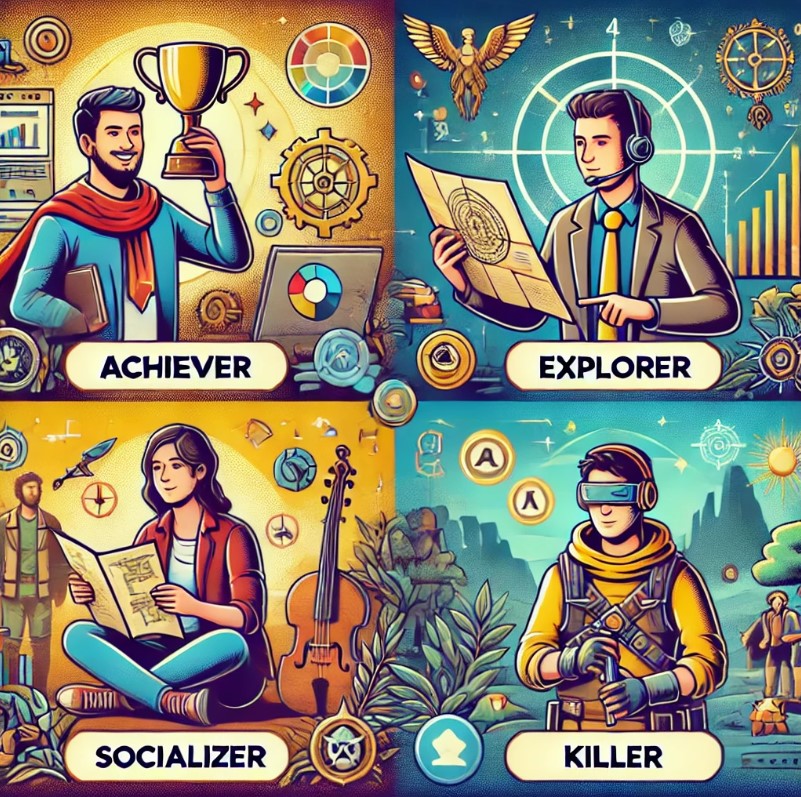
In manufacturing, gamification is often viewed as a playful addition rather than a transformative strategy. What if we operationalized gamification not as a gimmick but as a deliberate, player-focused tool to optimize productivity, engagement, and innovation? Richard Bartle’s taxonomy of player types—achievers, Explorers, Socializers, and Killers—provides a robust framework for designing gamified systems in manufacturing plants that resonate with diverse worker motivations.
The Four Player Types in Manufacturing Contexts
Bartle’s player types offer valuable insights into aligning individual motivations with operational goals.
1. Achievers: Motivated by Progression
Achievers thrive on measurable success; they are the operators who find satisfaction in meeting or exceeding production quotas, maintaining impeccable quality standards, and mastering new skills. For these individuals:
- Game Elements: Tiered skill badges, production leaderboards, or quality-focused achievement levels.
- Examples: A badge system where operators earn recognition for achieving “zero defect” runs or completing advanced training modules incentivizes achievers to upskill continually.
2. Explorers: Driven by Discovery
Explorers enjoy uncovering hidden opportunities, new techniques, or untapped efficiencies. They are your naturally curious workers who love experimenting with equipment settings or optimizing workflows.
- Game Elements: Create challenges that reward exploration, such as suggesting process improvements or discovering energy-saving measures.
- Examples: “Process Pioneer” recognition program that rewards employees for finding creative solutions to improve uptime or reduce material waste translates exploratory tendencies into operational excellence.
3. Socializers: Engaged by Interaction
Socializers prioritize collaboration and relationships. On the shop floor, they are the communicators who naturally form connections, mentor others, or build camaraderie during shifts.
- Game Elements: Design a team-based challenge, peer-recognition systems, or gamified mentoring programs.
- Examples: A shift-wide challenge where teams compete to improve cycle times fosters camaraderie. At the same time, a “Connector Badge” recognizes individuals who train and onboard new hires effectively.
4. Killers: Motivated by Competition
Killers thrive in competitive environments where they can assert dominance or showcase their expertise. In manufacturing, these are the go-to troubleshooters who relish tackling high-stakes problems or excelling in competitive tasks.
- Game Elements: Integrate PvP-style (peer-vs-peer) competitions, time-sensitive troubleshooting contests, or recognition for problem-solving under pressure.
- Example: A monthly “Troubleshooting Titan” award for solving the most complex machine breakdowns incentivizes Killers to channel their competitive drive into productivity.
Designing a Gamified Manufacturing System
A manufacturing plant must implement a layered system integrating recognition, incentives, and feedback into daily workflows to operationalize gamification using these player types. Here are the critical steps:
1. Identify Key Metrics: Determine what operational goals align with each player type. For example:
- Productivity metrics for Achievers.
- Efficiency innovations for Explorers.
- Team engagement for Socializers.
- Rapid problem resolution for Killers.
2. Build Gamified Feedback Loops: Create real-time dashboards that showcase progress, leaderboards, and accomplishments. Integrate these into existing software platforms for seamless visibility.
3. Incorporate Tangible Rewards: While intrinsic motivation is critical, tangible rewards like time off, gift cards, or even symbolic trophies can amplify engagement for all types.
4. Encourage Collaboration: Balance competition with opportunities for collaboration. Pair Killers with Socializers in team-based problem-solving games, or have Achievers mentor Explorers to accelerate learning.
5. Iteratively Improve: Just as manufacturing processes undergo continuous improvement, so too should gamification systems. Gather employee feedback to ensure the system remains engaging and fair.
The Strategic Impact
Gamification in a manufacturing environment isn’t just about making work “fun.” It’s about tapping into intrinsic motivations to enhance productivity, innovation, and job satisfaction. When tailored to Bartle’s player types, gamified systems become potent tools that align individual motivations with organizational objectives.
By understanding and embracing the diversity of motivations on the shop floor, manufacturing leaders can turn daily work into a game where everyone wins—employees feel valued and engaged, and the organization achieves operational excellence.
Let the game begin.
What’s your player type? Are you designing for Achievers, Explorers, Socializers, or Killers on your manufacturing team? Share your thoughts in the comments!
The information in this article was partially generated by OpenAI’s ChatGPT, an AI language model, and has been reviewed/edited for accuracy and relevance. OpenAI. (2024). ChatGPT [Large language model]. Retrieved from https://chat.openai.com/



 Wee Write
Leave a comment