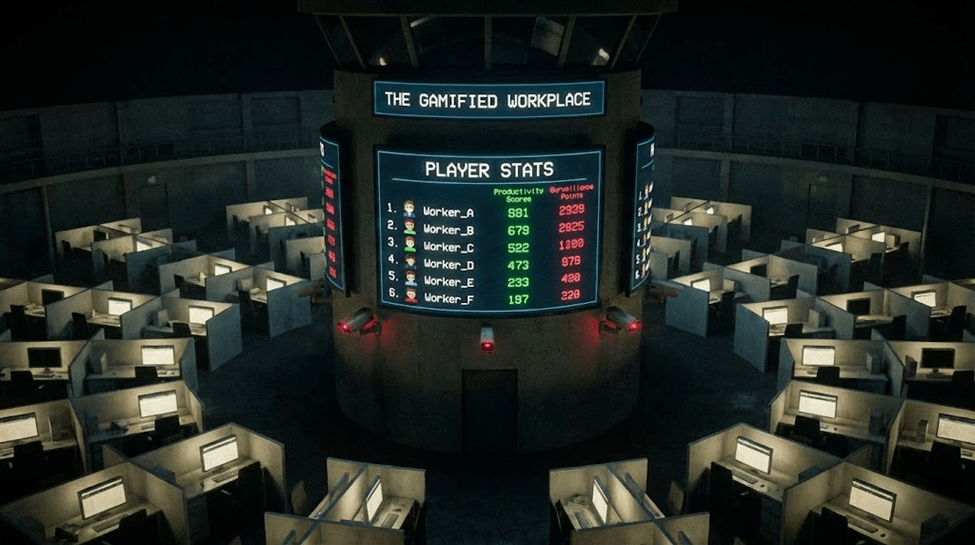
In the glossy brochures of HR tech vendors, corporate gamification is promised as the ultimate engagement tool. We are told that by tracking behavior and awarding points, we can turn the mundane grind of daily operations into an exciting quest.
But there is a fine line between data-driven engagement and data-driven control.
When we hook up every keyboard stroke, GPS location, and time-on-task metric to a “player dashboard,” we aren’t building a game. We are building a digital Panopticon—a prison where the “players” know they are constantly watched but never know exactly when the guard is looking.
When gamification crosses this line, it stops motivating and starts terrifying. Here is a look at the psychology, the culture shift, and the inevitable cheating that arises when surveillance is disguised as a game.
The Psychology: The Anxiety of the Invisible Eye
The fundamental prerequisite for a high-performing team is psychological safety—the belief that you won’t be punished for making a mistake or voicing a dissenting opinion.
Surveillance-based gamification destroys this.
When an employee knows their “activity score” drops if their mouse doesn’t move for 3 minutes, their cognitive focus shifts. They stop thinking deeply about complex problems (which requires stillness and thought) and start worrying about maintaining “perceived activity.”
In Octalysis terms, this is a massive over-reliance on Core Drive 8 (Loss & Avoidance). The motivation isn’t the joy of winning; it’s the fear of being flagged by the algorithm. This constant low-grade anxiety spikes cortisol and burns out top performers, who resent being managed by a stopwatch rather than their actual results.
The Culture: The Rise of Performative Busyness
When you gamify input (hours logged, emails sent, keystrokes made) rather than output (problems solved, projects delivered), you create a culture of performative busyness.
Trust evaporates. A manager no longer looks an employee in the eye to gauge their workload; they look at a dashboard to see their “focus score.” The culture shifts from “We trust you to get the job done” to “We trust the data more than you.”
This environment rewards the wrong people. The employee who loudly churns through low-value emails gets a high score on the leaderboard. The deep thinker who spends four hours strategizing a major operational breakthrough looks “inactive” to the system. The culture learns to value noise over signal.
The Cheating: Gaming the Tracker
If you design a game where the rules are unfair, players will inevitably cheat. It’s human nature to optimize for the stated reward mechanism.
When employees realize they are playing a surveillance game, they don’t work harder; they work smarter at beating the system.
We see the rise of physical “mouse jigglers” to keep Teams status green. We see employees writing scripts to open and close documents to simulate activity. We see staff padding audit reports with trivial findings just to bump their “issues logged” stats.
The tragedy is that the innovation and creativity of the workforce are diverted away from solving business problems and toward outsmarting the surveillance tools. The “game” becomes a cat-and-mouse battle between management’s tracking software and the employees’ evasion tactics.
Conclusion: Measure Outcomes, Not Keystrokes
True gamification should empower employees (Core Drive 3) and give them a sense of progress (Core Drive 2). If your system feels less like a fun challenge and more like an ankle monitor, it’s time to review.
Use data to identify bottlenecks in your processes, not to spy on your people. Trust is the ultimate efficiency hack, and no amount of gamified surveillance can replace it.



 Wee Write
Leave a comment