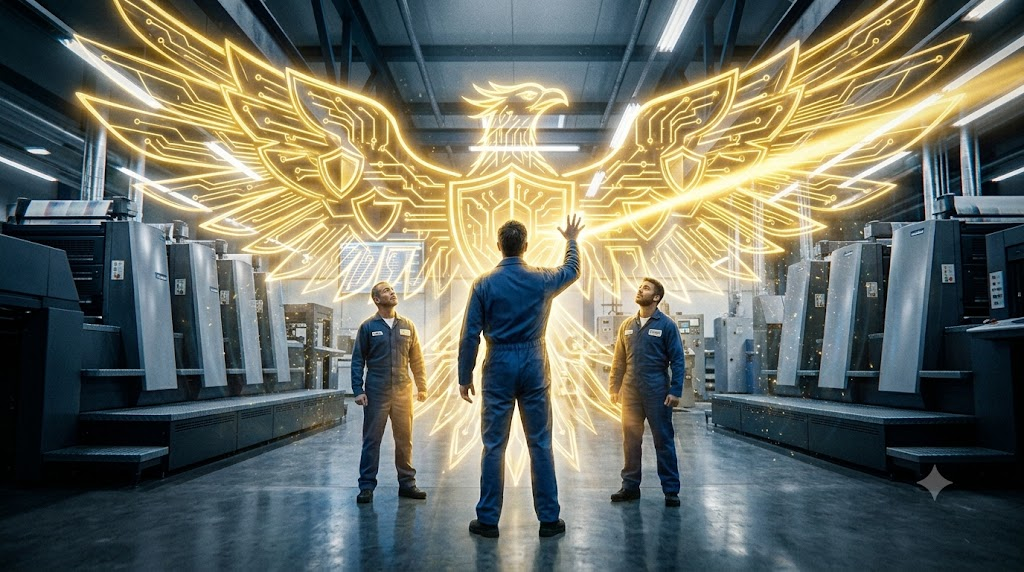
There is a massive difference between having a good idea and creating structural armor. A good idea makes you feel optimistic in the breakroom. Structural armor makes you absolutely invincible in the marketplace.
When an organization goes through a divestment, the standard corporate playbook tells us to look attractive to a buyer by cleaning up our spreadsheets, cutting back on “unoptimized” activities, and playing defensively. We are taught to present ourselves as a compliant, safe acquisition.
But true defiance whispers a completely different command: My destiny is shaped by me, not by heaven.
Instead of waiting for a buyer to dictate our worth, we take the operational weapons we discovered in our customer’s pain and forge them into what Eli Goldratt calls a “Mafia Offer”—an commercial proposal so structurally brilliant, so overwhelmingly beneficial to the client, that they cannot say no, and our competitors cannot safely copy it.
In It’s Not Luck, Pete’s printing division did exactly this. They were losing millions to massive industry giants with high-speed rotogravure presses. They couldn’t out-invest them, so they decided to out-logic them.
They launched the “Usable-Unit Offer.” Knowing that buyers were terrified of getting stuck with obsolete wrapper inventory due to sudden marketing changes, Pete’s team offered clients a low, high-volume price based on a two-month horizon, but committed to shipping smaller quantities every two weeks. Most audaciously, they gave the buyer the absolute right to cancel the remainder of the order at any time with zero penalty.
The competitors looked at this offer and froze. Trapped in their traditional, rigid cost-accounting mindsets, the giant printers couldn’t run their massive machines for small, non-optimized setups without showing huge internal “efficiency losses” on their spreadsheets. They couldn’t copy the offer without completely rewriting their internal corporate rules. Pete’s team had successfully weaponized their own flexible setups to create a monopoly.
But building the armor was only half the battle; the team had to learn how to wear it. Initially, the salespeople failed because the offer sounded “too good to be true” and triggered deep buyer skepticism.
So, the team built a flawless logic blueprint for their sales calls. Instead of walking into a client’s office aggressively pitching their printing presses, the salespeople opened the meeting by walking the buyer through an analysis of the buyer’s own daily inventory and cash headaches. For the first fifteen minutes, they didn’t mention their product at all.
Once the buyer sat back, deeply understood and relieved that someone finally grasped their daily misery, the salesperson introduced the transition logic. They proved mathematically that their new policy safely absorbed every ounce of the buyer’s financial risk.
When you stop begging for a corporate future and instead design an operational model that fundamentally shifts the risk away from your customers, you alter your destiny. You are no longer an asset up for liquidation. You are a highly synchronized, structurally protected market force.
In the next and final post: The climax. We will look at what happens when this “Mafia Offer” hits the real world, how it blows the predatory divestment landscape completely apart, and what it truly means to eat the competitors for breakfast.



Leave a Reply