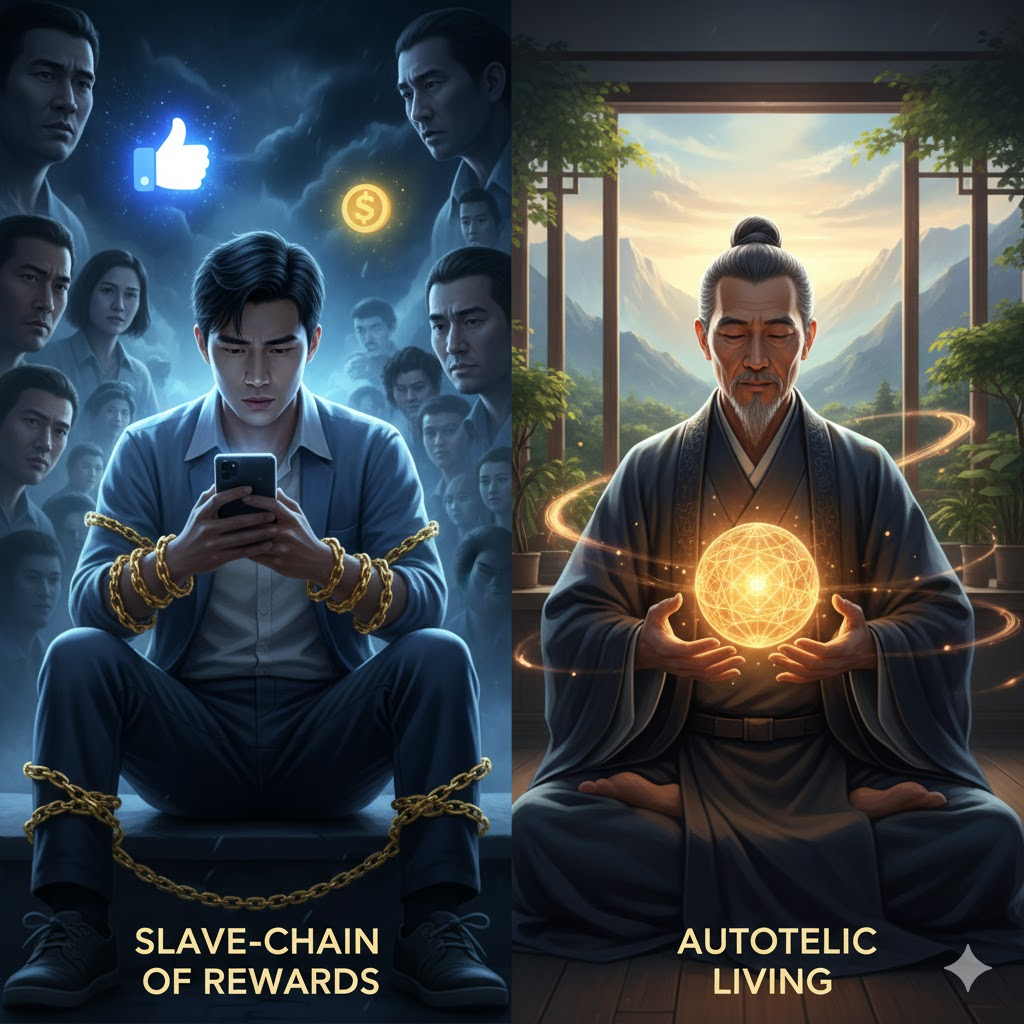
In the corporate world of 2026, we are conditioned to be Exoteric—meaning we look for the “outside” reward. We work for the bonus, we post for the likes, we lead for the title. While these aren’t inherently bad, they create a dangerous psychological dependency: If Heaven owns the reward, Heaven owns you.
Wang Yangming lived this truth. As a high-ranking official, he was once a star of the Imperial court. When the rewards were taken away and replaced with lashes and exile, most men would have shriveled up. But Wang thrived. Why? Because he had mastered Autotelic Living.
The “Self-Contained” Life
The word Autotelic comes from the Greek auto (self) and telos (goal). In Mihaly Csikszentmihalyi’s research, an autotelic person is someone whose goals come from within. They don’t do the work to get somewhere; the doing is the getting.
- Exoteric (Slave to Fate): I am writing this report so my boss won’t yell at me. (High anxiety, low control).
- Autotelic (Master of Destiny): I am writing this report to practice the “Bright Heart” of clarity and precision. (High flow, total control).
Wang Yangming’s “Secret” Reward
When Wang was in the jungles of Guizhou, he wasn’t being paid. He had no “audience” to impress. Yet, he spent his days lecturing his sick servants and carving stone. He was practicing 此心光明 (This heart is bright) as an end in itself.
He realized that if the “Innate Knowing” (Liangzhi) approves of your action, you have already received the highest possible “bonus.” You are no longer waiting for a year-end review from the Emperor; you are conducting a second-by-second review of your own soul.
How to Transition to Autotelic Mastery
To reclaim your destiny from the “Reward-Chasers,” apply these three shifts:
1. Redefine the “Win”
Instead of defining success by the outcome (which is controlled by “Heaven” or your company), define it by the Quality of Presence.
- The Shift: “I win if I stay in Flow for 60 minutes,” rather than “I win if they buy my proposal.”
2. Find the “Internal Game”
In every boring or stressful task, create a hidden challenge for your skills.
- The Practice: If you are in a tedious safety meeting at the plant, your “Internal Game” is to practice active listening and empathy for the speaker. You are training your “Sage muscles” while everyone else is just “checking out.”
3. The “No-Validation” Rule
Practice doing one high-quality act every week that no one will ever find out about. No LinkedIn post, no mention in a meeting.
- The Lesson: This proves to your ego that your “Bright Heart” doesn’t need external batteries to stay lit.
Your Autotelic Exercise
Identify one task on your to-do list today that you “hate” because it feels thankless.
- Stop the Leak: Notice how much energy you waste wishing someone would recognize your effort.
- Set the Internal Goal: Choose one skill (clarity, patience, speed) to practice during this task.
- The Silent Prize: When you finish, check in with your heart. If you did it well, say to yourself: “此心光明” (This heart is bright). That is your only reward—and it’s the only one that can’t be taken away.
我命由我不由天. When the reward is inside the action, you are no longer a beggar for the world’s approval. You are the master of your own fulfillment.
-由 Edward Wee 构思,人工智能 (Gemini) 敬撰-




Leave a Reply